The Marchi family's legacy is built and defined on the basis of two complementary principles: managing assets to create value and leaving the next generation more than what was received.
There are also two fundamental and essential points from which the Marchi family starts when developing and building business projects: maximum product quality, maximum attention to worker safety, and respect for the environment.
These are the principles, never betrayed, that describe how Marchi operates.
This approach tells the story of a Florentine family that considers economy and austerity to be fundamental rules to be passed on in education, and the ostentation of wealth to be a weakness that must not be indulged.
Anything that is appearance without content, anything that is form without substance, is of no concern to them.
Uncompromising honesty, respect, and courage in one's actions are the basis of a code of conduct that inspires the Marchi family's actions both in their personal lives and in the management of their family businesses.
These are the values on which the Marchi family has always based its relationship of great openness and sensitivity with its employees. In the past as in the present, solutions are implemented that meet the needs of employees, with a view to building a relationship in which everyone, in defining and respecting individual roles and positions, can feel that they belong to a great project under construction that could not exist without the work of all.
This is because the company strongly believes in teamwork and consequently encourages it. Decisions are never made individually but are discussed and shared. Employees are involved in taking responsibility as well as in sharing the results. Within this very clear and lucid vision of the values to be respected, there is room for an open-mindedness that does not stop at conventions or the most obvious decisions.
This non-conformist spirit clearly characterized the personality of Carlo Marchi, president of Marchi since 1979, and drove him to lead the company with great attention to flexibility and speed in decision-making, in order to provide concrete and timely responses to threats, seizing opportunities as they arose.
Carlo was an entrepreneur who used his solid background to continue building and innovating. Carlo Marchi was an impatient man who believed in action and practicality, in the rapid transition from theory to practice, and in measuring entrepreneurial activity on the basis of concrete results. From the outset, he was supported in the management of the company by Silvano Scarpelli, whose contribution was fundamental to the growth of the Marchi Group.
Although they had different characters and personalities, both recognized themselves in the same code of conduct: they believed in Honesty, in the broadest sense of the term, in Respect for others, in the value of Courage, and in the importance of taking responsibility. Their equally pragmatic view of the fundamental aspects of life led them to manage the company for thirty years in accordance with these values and to determine its continuous growth: net profits of over €30 million with an average annual return of 18% on their invested capital.
The strength of Carlo Marchi and his company lies in the awareness of being at the center of a story that is a passage of knowledge handed down from one generation to another. It is precisely the ability to use all the lessons learned from experience that allows them to keep their eyes on the future.
It was with this in mind that Ferruccio Marchi and Massimo Scarpelli joined the company in the 1990s to work alongside their parents. They represent the new generation, the ideal custodians of ancient values and knowledge and experience accumulated over five generations, a precious and rare knowledge that continues to exist and expand through their work.
And so the company has continued on its path of growth and self-financing, which today leads it to have a consolidated net worth of over 37 million and total independence from the banking system.
from an idea by Cavalier Ferruccio Marchi, fond of chemistry, who was able to see the possibility to use animal bones, at that time used by carpenters to obtain glue, to extrapolate a chemical product.He discovered that by treating animal bones with oil of vitriol, namely sulphuric acid, they could become monocalcium phosphates or superphosphates, excellent fertilizers.
This is the history of a man who very bravely decided to challenge the perplexities of his townsmen of Pescia, and that alone, by investing his few belongings (the legend has it that he even sold his wife’s gold chain) started this enterprise.
The Marchi company was then officially born in 1873 in Pescia and for a long time, indeed starting from its origins, was nicknamed “La fabbrica dell’ossi” (The bone factory).Within a few years the business grew considerably and improved with the production of superphosphate, mineral, obtained through the treatment of phosphorites with sulphuric acid.
Given this strong growth, the factory of Pescia appears inadequate because of its geographical location, away from Livorno, where the materials needed to manage the entire production are landed, but it is important to keep in mind that this was the pilot plant that served as a model and guide for the future factories.
In 1899 the factory of Marano Veneziano for the production of chemical fertilizers opened.
The choice of the geographical location is determined both by the ease of obtaining raw materials by rail and waterways, and by the proximity of large agricultural consumption areas. This factory has been an excellent example of industrial architecture since the end of the Nineteenth century. The plant and the geometry of the structure, tailored to the needs of a certain type of production, have undergone restructuring and significant adjustments, anyway respectful and in harmony with the original base plant.
In the factory in Marano the best technological knowledge of the time, enriched by the experience gained in the factory of Pescia, were used; thus, a plant for the production of sulphuric acid with the "lead chambers" system and a system for the production of superphosphate mineral was created.
The real change came in 1910, when the family acquired the mine of Ravi, rich in deposits of pyrite, which, at that time was the essential raw material for the production of sulphuric acid. This choice, which allows obtaining sulphuric acid directly, would prove to be very successful and allowed the company to grow more and more.
In 1923 the factory of Livorno for the production of sulphuric acid and mineral superphosphate opened.
During the war the factories were destroyed, but the Marchi family rebuild them quickly.
Meanwhile Ferruccio’s children, Carlo and Giulio, join their father in the management of the company, giving it a more and more modern connotation, open to the specific requirements of the fertilizer market.
In 1970 the factory of Pescia was closed and after two years, in 1972, the factory of Livorno was closed, too. Since that time, the Marchi’s chemical activity was concentrated in the factory of Marano.
From the late Seventies Carlo Marchi and Silvano Scarpelli have been managing the company, therefore taking up the challenge started by their great-great grandfather Ferruccio Marchi, and again put innovation research at the core of their projects of to create quality value.
In 1984 Marchi, under the name of Marchi Industriale S.p.A., takes the configuration of holding and (initially) incorporates a number of companies in central and southern Italy, specialized in the transformation of chemicals according to their marketing.
Currently, the chemical activity of the Marchi Group is concentrated in the factory of Marano Veneziano, where two systems for the production of potassium sulphate and hydrochloric acid, a system for the production of sulphuric acid from elemental sulphur, obtained through catalytic process, a system for the production of LAS (sulphonic acid) and a bagging line of water soluble fertilizers have been built.
Only case in Italy, a system for the production of high-purity sulphuric acid: the reagent grade or analytical purity, is designed and implemented.
Four production lines of FLOMAR®, the product used directly in the production process of the paper industry and as flocculant for water treatment and clarification are added to these systems.
In 2004, with the birth of Essemar S.p.A., the result of a joint venture with Esseco Group Srl, and aimed at the construction of a factory for the manufacturing and sale of sulphuric acid and oleum with a capacity of 150,000 t/year at the production site of San Martino di Trecate (Novara), Marchi Industriale takes a leading role in the domestic market of sulphuric acid.
A further diversification and important step in the Marchi Groups activity regards the development of a specific know-how for the manufacture of potassium sulphate.
Drawing on the experience gained over the years and in the perspective of creating innovation and better opportunities, Marchi Industriale has developed a technologically advanced industrial process for the manufacture of potassium sulphate. This know-how is used by both Marchi in its production site of Marano and by the engineering company Desmet Ballestra for the construction and sale of systems for third parties.
Today Marchi Industriale is a leader in Italy in the production of potassium sulphate.
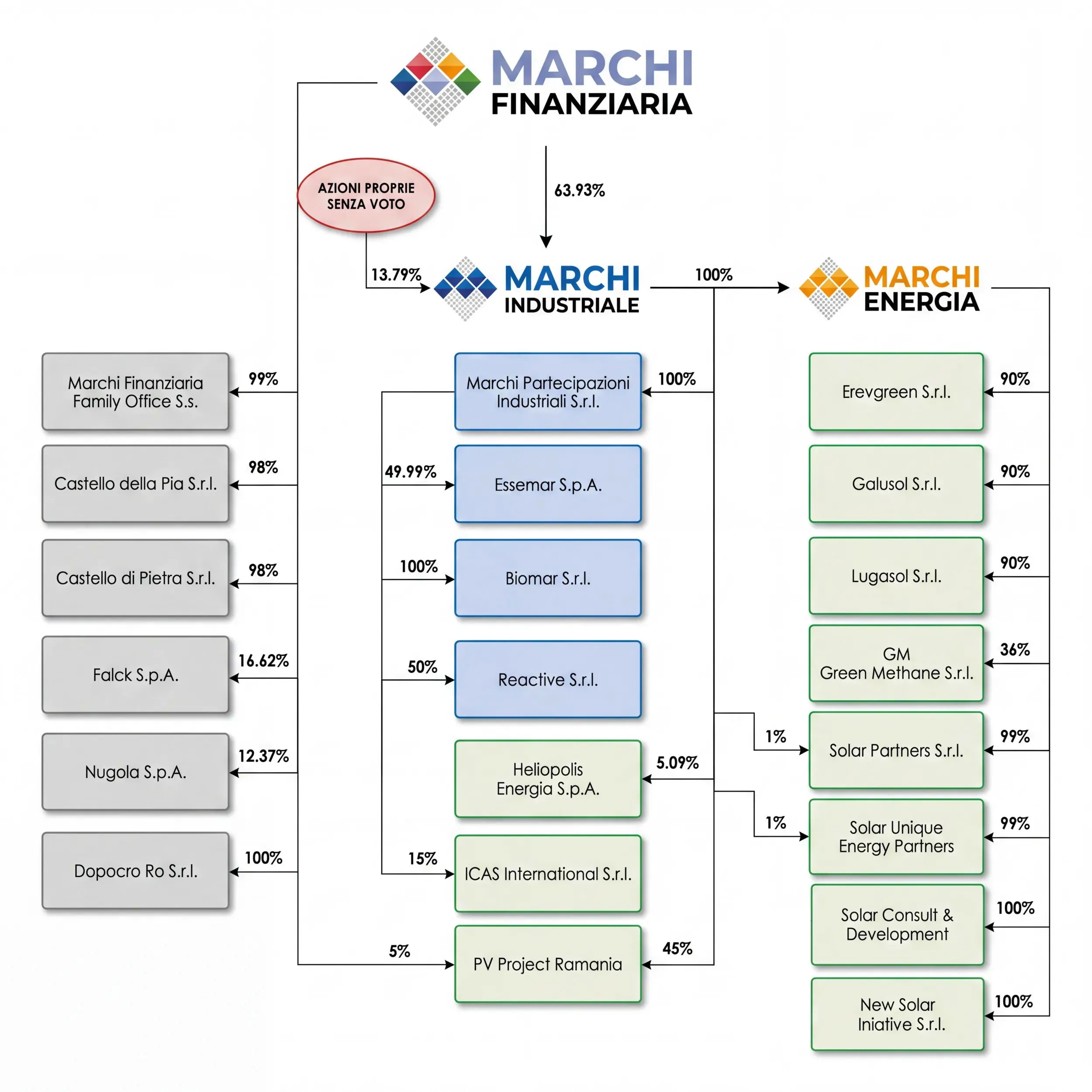
In 2010, the Group undertook a new initiative in the field of renewable energy with the incorporation of Marchi Energia Srl, appealing to the possibility to:
Transfer the technical and system know-how deriving from the main business in the renewable energies sector.
Invest in an opportunistic and fast way in the countries, where there are the most interesting rate conditions, owing to know-how, decision-making speed and availability of capitals to invest full equity, without getting into debts.
Marchi Energia S.r.l. operates as sub-holding company of renewable energy business.
In 2013, within the objective of diversification and development of activities, GM Green Methane (GM) was born from the meeting between the Marchi Group and the Giammarco Vetrocoke Group. The company has developed its own technology for the purification of biogas to biomethane, process in which the removal of the carbon dioxide contained in the biogas is the main operation.
In the same year Marchi Finanziaria S.r.l. was born from the merging of Carlo Marchi e Gioia Falcks assets and it is the holding company of the Marchi family and the controlling shareholder of Marchi Industriale, with a 63.9398% participation.
On the 4th of May 2017 Marchi Industriale has achieved the Elite Certificate of Borsa Italiana.
Besides managing both the core business and the two related plants, one located in Marano Veneziano, the other in Trecate, the Group singled out a further important means of diversification and growth of activities in special fertilizers sector, where th newly-created Marchi Agro S,p,A, takes over the role of sub-holding of the agricolture division.
Today, Ferruccio Marchi is leading the group, joined by Filippo Marchi and Federico Marchi.
The operational centre of the Group is located in Florence, in one of the most charming areas of the city.
In 2022, Marchi Industriale took a significant step forward in its logistics infrastructure, investing in the construction of a new 6,000-square-meter storage warehouse within its plant.
This expansion increased the storage capacity of raw materials and finished products by more than 18,500 tons, improving operational efficiency and responding more effectively to market needs.
In 2024, Marchi Industriale started a major expansion project: the construction of a new plant for the production of Potassium Sulfate and Hydrochloric Acid. This investment will double the production capacity of the current plant through the addition of two new reactors made of refractory material using Mannheim Cycle technology.
The expansion is a strategic step to strengthen our position in the industry, ensuring greater efficiency and sustainability. Construction is currently underway and marks another step in our commitment to industrial innovation.
Stay tuned for more updates on this project that will mark a new chapter in our growth!
Laureato in Scienze dell’Informazione presso l’Università degli Studi di Pisa. Amministratore Delegato di Marchi Finanziaria S.r.l., Presidente di Marchi Energia S.r.l. e GM Green Methane S.r.l., Vice Presidente di Essemar S.p.A.
Ricopre il ruolo di Consigliere di Amministrazione in varie altre società del Gruppo partecipate da Marchi Finanziaria. Consigliere della Fondazione Carlo e Giulio Marchi, della Fondazione Carlo Marchi e della Fondazione Giulio Marchi.
Laureato in Economia e Commercio all’Università Bocconi di Milano. Amministratore delegato di Castel delle Pia S.r.l. e Castel di Pietra S.r.l. Vice presidente e Consigliere di Marchi Industriale S.p.A. Consigliere di Marchi Finanziaria S.p.A.
He graduated in Computer Science from the University of Pisa.
Chief Executive Officer of Marchi Finanziaria S.r.l., Chairman of Marchi Energia S.r.l. and GM Green Methane S.r.l., Vice Chairman of Essemar S.p.A.
He serves as board director in various other group companies held by Marchi Finanziaria. Board member of the Carlo and Giulio Marchi Foundation, the Carlo Marchi Foundation and the Giulio Marchi Foundation.
He graduated in Economics from Bocconi University in Milan.
Chief Executive Officer of Castello della Pia S.r.l. and Castel di Pietra S.r.l.; Vice President and Managing Director of Marchi Industriale S.p.A.; Director of Marchi Finanziaria S.p.A.
He graduated in Chemical Engineering from the University of Pisa.
He began working at Marchi Industriale in 1986 as R&D Manager. He is Managing Director of Marchi Energia S.r.l. and of GM Green Methane S.r.l., for which he oversaw the start‑up phase.
He holds a degree in Chemistry.
With Marchi Industriale since 2003 as Sales Manager and Raw Materials Purchasing Manager; previously Sales Manager for Galbert S.r.l.; started his career as head of department in Cromos S.p.A.
He graduated in Electronic Engineering from the University of Padua.
With Marchi Industriale since 1994 as Manager of the electro‑instrumental division; in 1999 became Plant Technical Services Manager; in 2001 assumed responsibility for the Prevention and Protection Service; from 2010 involved in staff training in safety and security. He began his career in 1994 at Microelettric, designing an inverter for railway cars commissioned by Ferrovie dello Stato.
He graduated in Economics and Commerce from the Polytechnic University of Marche.
Joined Marchi Industriale Group in 2019 as Administration, Finance and Control Manager; previously CFO for Filippetti Group; formerly Foreign Countries Financial Manager at Renco S.p.A.
Laureato in Scienze dell’Informazione presso l’Università degli Studi di Pisa. Amministratore Delegato di Marchi Finanziaria S.r.l., Presidente di Marchi Energia S.r.l. e GM Green Methane S.r.l., Vice Presidente di Essemar S.p.A.
Ricopre il ruolo di Consigliere di Amministrazione in varie altre società del Gruppo partecipate da Marchi Finanziaria. Consigliere della Fondazione Carlo e Giulio Marchi, della Fondazione Carlo Marchi e della Fondazione Giulio Marchi.
Laureato in Economia e Commercio all’Università Bocconi di Milano. Amministratore delegato di Castel delle Pia S.r.l. e Castel di Pietra S.r.l. Vice presidente e Consigliere di Marchi Industriale S.p.A. Consigliere di Marchi Finanziaria S.p.A.